
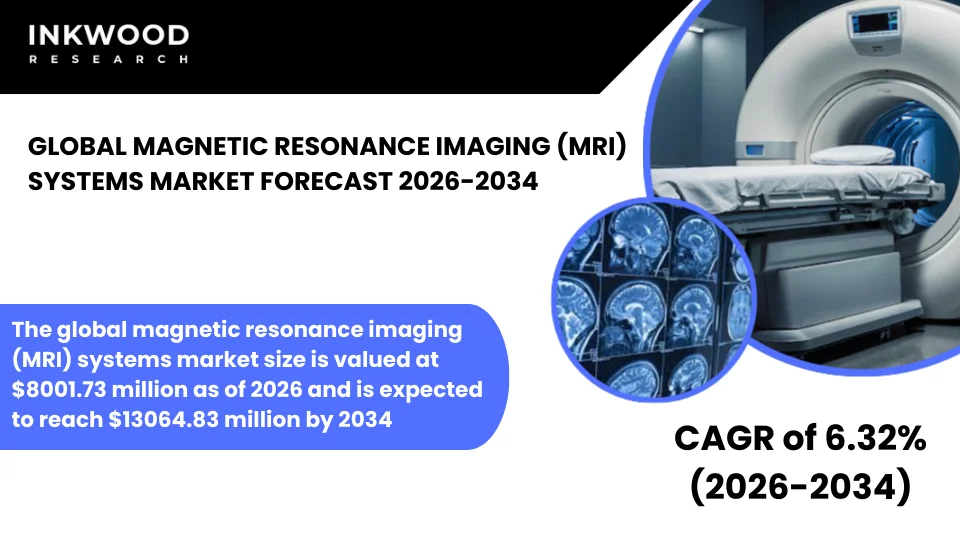
GLOBAL MAGNETIC RESONANCE IMAGING (MRI) SYSTEMS MARKET FORECAST 2026-2034
世界の磁気共鳴画像法(MRI)システム市場:アーキテクチャ別(クローズドMRIシステム、オープンMRIシステム)、磁場タイプ別市場(高磁場システム、低中磁場システム、超高磁場システム)、アプリケーション別市場(脳神経MRIシステム、脊椎および筋骨格MRIシステム、骨盤および腹部MRIシステム、腫瘍MRIシステム、血管MRIシステム、心臓MRIシステム、小児MRIシステム、消化器MRIシステム、その他のアプリケーション)、および地域別
Global Magnetic Resonance Imaging (MRI) Systems Market by Architecture (Closed MRI Systems, Open MRI Systems) Market by Field Type (High Field System, Low-Mid Field Systems, Ultra High Field Systems) Market by Application (Brain and Neurology MRI System, Spine and Musculoskeletal MRI System, Pelvic and Abdominal MRI System, Oncology MRI System, Vascular MRI System, Cardiology MRI System, Pediatric MRI System, Gastroenterology MRI System, Other Applications), and Geography
| 出版 | Inkwood Research |
| 出版年月 | 2026年02月 |
| ページ数 | 329 |
| 価格 | 記載以外のライセンスについてはお問合せください |
| シングルユーザ | USD 2,900 |
| 種別 | 英文調査報告書 |
| 商品番号 | SMR-1337313373 |

世界の磁気共鳴画像法(MRI)システム市場規模は、2026年時点で80億173万ドルと推定されており、2034年には1億30億6483万ドルに達すると予測されています。予測期間は2026年から2034年で、年平均成長率(CAGR)は6.32%です。本市場調査では、危機が磁気共鳴画像法(MRI)システム市場に与える影響についても、定性面と定量面の両方で分析しています。
磁気共鳴画像法(MRI)システムは、強力な磁場と電波を用いて体内の詳細な画像を生成する高度な医療診断機器です。CTスキャン技術とは異なり、これらのシステムは電離放射線被曝なしに優れた軟部組織の可視化を提供します。核磁気共鳴画像診断法(NMR)は、強力な磁場における水素原子の挙動を利用し、高解像度の解剖学的および機能的画像を生成します。
世界中の医療機関では、神経疾患、筋骨格系損傷、心血管疾患、腫瘍学的評価の診断にこれらのシステムを導入しています。高度なMRI技術は、基本的な画像診断から、機能的MRI、拡散イメージング、分光法などの機能を含むように進化しています。最新のシステムには、画質を向上させると同時にスキャン時間を大幅に短縮する人工知能アルゴリズムが組み込まれています。
KEY FINDINGS
The global magnetic resonance imaging (MRI) systems market size is valued at $8001.73 million as of 2026 and is expected to reach $13064.83 million by 2034, growing at a CAGR of 6.32% during the forecast period 2026-2034. The base year considered for the study is 2025, and the forecast period is between 2026 and 2034. The market study has also analyzed the crisis impact on the magnetic resonance imaging (MRI) systems market qualitatively as well as quantitatively.
Magnetic resonance imaging systems represent sophisticated medical diagnostic equipment utilizing powerful magnetic fields and radio waves to generate detailed internal body images. Unlike CT scan technology, these systems provide superior soft tissue visualization without ionizing radiation exposure. Nuclear magnetic resonance imaging leverages hydrogen atom behavior in strong magnetic fields to produce high-resolution anatomical and functional images.
Healthcare facilities worldwide deploy these systems for diagnosing neurological disorders, musculoskeletal injuries, cardiovascular conditions, and oncological assessments. Advanced MRI technology has evolved from basic imaging to include functional MRI, diffusion imaging, and spectroscopy capabilities. Modern systems incorporate artificial intelligence algorithms that enhance image quality while significantly reducing scan times.
Healthcare infrastructure expansion across emerging economies drives substantial MRI systems market growth globally. Rising chronic disease prevalence necessitates advanced diagnostic imaging capabilities that only sophisticated magnetic resonance imaging provides. Technological innovations, including AI integration, ultra-high-field systems, and portable MRI devices, accelerate market penetration.
Growing preference for non-invasive diagnostic procedures over exploratory surgeries increases utilization rates substantially. Moreover, government initiatives promoting accessible healthcare services and diagnostic infrastructure development fuel capital equipment investments. Insurance coverage expansion for advanced imaging procedures removes financial barriers for patients. Consequently, hospitals and diagnostic centers prioritize MRI system acquisitions to meet escalating demand.
MARKET INSIGHTS
Key enablers of the global magnetic resonance imaging (MRI) systems market growth:
- Rising prevalence of chronic and neurological diseases is accelerating the need for sophisticated imaging techniques that MRI technology provides
- Technological advancements, including AI integration, high-resolution imaging, and faster scanning capabilities, are encouraging adoption across healthcare facilities
- Increasing healthcare expenditure and infrastructure development in emerging economies are boosting market penetration and capital equipment purchases
- Expanding outpatient services and a shift toward non-invasive diagnostics are making MRI systems more frequently utilized across care settings
o Expanding outpatient services transform how healthcare providers deliver diagnostic imaging services today. Traditional hospital-centric models no longer dominate the MRI market landscape exclusively. Ambulatory surgical centers, imaging centers, and specialty clinics increasingly install advanced MRI systems. Patients prefer convenient outpatient facilities over hospital visits for routine diagnostic procedures.
o Furthermore, insurance reimbursement structures increasingly favor cost-effective outpatient imaging over expensive hospital-based scans. This shift toward non-invasive diagnostics creates new market opportunities for compact and portable MRI technologies. Consequently, manufacturers develop systems specifically designed for outpatient settings with reduced footprints and simplified workflows.
Key growth restraining factors of the global magnetic resonance imaging (MRI) systems market:
- High acquisition, installation, and maintenance costs of MRI systems remain a significant barrier for smaller facilities and low-resource regions
- Limited access in rural and underdeveloped areas persistently restricts broader market reach and equitable care delivery
- Shortage of skilled personnel and radiologists for operating advanced MRI machines hinders optimal utilization and scanning capacity
- Stringent regulatory requirements and complex approval processes can delay market entry for new MRI technologies
o Stringent regulatory requirements establish comprehensive safety and efficacy standards for magnetic resonance imaging equipment. The FDA enforces rigorous premarket approval processes requiring extensive clinical validation data. Manufacturers must demonstrate compliance with electromagnetic compatibility standards and patient safety protocols. International harmonization efforts through ISO standards add complexity to global market entry strategies.
o Additionally, each market region imposes unique regulatory frameworks requiring separate approval processes. Compliance costs escalate significantly when navigating multiple regulatory jurisdictions simultaneously. Device modifications necessitate supplementary approvals that delay commercial availability substantially. Therefore, smaller manufacturers struggle to compete against established players with robust regulatory expertise and resources.
Global Magnetic Resonance Imaging (MRI) Systems Industry | Top Trends
- AI algorithms revolutionize how radiologists interpret magnetic resonance imaging scans today. Machine learning models automatically detect abnormalities, prioritize critical findings, and reduce interpretation time significantly. Deep learning techniques enhance image reconstruction quality while minimizing scan duration and patient discomfort. Furthermore, AI-powered workflow optimization allocates scanner resources efficiently across patient volumes. Predictive maintenance algorithms anticipate equipment failures before disruptions occur. Major MRI manufacturers partner with technology companies to embed AI capabilities directly into their systems. Consequently, healthcare facilities investing in AI-enabled MRI systems achieve faster throughput and improved diagnostic confidence.
- Portable MRI devices represent a paradigm shift from traditional room-sized installations to mobile diagnostic solutions. Low-field systems operate at reduced magnetic strengths yet deliver clinically valuable imaging for specific applications. These compact devices serve emergency departments, intensive care units, and remote healthcare facilities effectively. Moreover, portable systems eliminate patient transport risks associated with moving critically ill individuals. Manufacturers like Hyperfine pioneered FDA-cleared portable MRI systems, transforming point-of-care imaging capabilities. Lower acquisition costs make advanced imaging accessible to facilities previously unable to afford conventional systems. Therefore, this trend democratizes access to magnetic resonance imaging technology globally.
- Patient experience considerations increasingly drive MRI system selection among healthcare administrators today. Claustrophobic patients often require sedation or refuse traditional closed-bore MRI examinations entirely. Open MRI systems feature wider apertures and less confining configurations that reduce anxiety significantly. Additionally, acoustic noise reduction technologies minimize the loud sounds characteristic of conventional MRI scanning. Faster imaging sequences decrease examination duration from 45 minutes to under 20 minutes. Pediatric-friendly designs incorporate colorful themes and entertainment systems that distract young patients effectively. Consequently, facilities prioritizing patient satisfaction invest in comfort-enhancing MRI technologies despite premium pricing.
- Healthcare delivery models increasingly emphasize convenience and cost-effectiveness over traditional hospital-based services. Free-standing imaging centers capture growing market share from hospital radiology departments through competitive pricing. Retail healthcare clinics incorporate diagnostic imaging capabilities, including MRI services, within accessible locations. Telemedicine integration enables remote radiologist interpretation regardless of scanning location. Furthermore, value-based reimbursement models reward efficiency and patient outcomes over service volume. Outpatient MRI facilities operate with lower overhead costs, enabling more competitive service pricing. Therefore, this ambulatory shift reshapes competitive dynamics across the MRI systems market landscape.
SEGMENTATION ANALYSIS
Market Segmentation – Architecture, Field Type, and Application –
Market by Architecture:
- Closed MRI Systems
o Standard Bore MRI Systems
- Standard bore magnetic resonance imaging systems represent the most widely deployed MRI architecture globally. These systems feature traditional cylindrical bore designs measuring 60 centimeters in diameter, typically. Clinical applications requiring high-resolution imaging particularly benefit from standard bore configurations. Hospital radiology departments predominantly install standard bore systems given their proven diagnostic capabilities.
- Moreover, these systems accommodate the broadest range of imaging protocols and advanced sequences. Manufacturers continuously refine standard bore designs, improving patient access and reducing examination times. Technological advancements enable slimmer patient tables and streamlined bore entry procedures.
- Consequently, standard bore systems maintain a dominant MRI market share despite growing alternatives. Healthcare facilities value the versatility standard bore configurations provide across diverse patient populations. Research institutions prefer standard bore systems for investigational studies requiring precise imaging specifications.
o Wide Bore MRI Systems
- Open MRI Systems
Market by Field Type:
- High Field System
o 1.5T System
o 3T System
- Low-Mid Field Systems
- Ultra High Field Systems
Market by Application:
- Brain and Neurology MRI System
- Spine and Musculoskeletal MRI System
- Pelvic and Abdominal MRI System
- Oncology MRI System
- Vascular MRI System
- Cardiology MRI System
- Pediatric MRI System
- Gastroenterology MRI System
- Other Applications
REPORT SYNOPSIS
| REPORT SCOPE | DETAILS |
|---|---|
| Market Forecast Years | 2026-2034 |
| Base Year | 2025 |
| Market Historical Years | 2022-2024 |
| Forecast Units | Revenue ($ Million) |
| Segments Analyzed | Architecture, Field Type, and Application |
| Geographies Analyzed | North America, Europe, Asia-Pacific, Rest of World |
| Companies Analyzed | Analogic Corporation, Aurora Imaging Technology Inc, Canon Medical Systems Corporation, Carestream Health Inc, Esaote SpA, FONAR Corporation, FUJIFILM Holdings Corporation, GE HealthCare, Hologic Inc, Konica Minolta Inc, Medtronic plc, Mindray Medical International Limited, Philips Healthcare, Shimadzu Corporation, Siemens Healthineers |
REGIONAL ANALYSIS
Geographical Study based on Four Major Regions:
- North America: The United States and Canada
- Europe: The United Kingdom, Germany, France, Italy, Spain, Poland, Belgium, and Rest of Europe
- Asia-Pacific: China, India, Japan, Australia & New Zealand, South Korea, Thailand, Indonesia, Vietnam, and Rest of Asia-Pacific
o China represents the fastest-expanding magnetic resonance imaging systems market within the Asia-Pacific region currently. Government healthcare reforms prioritize diagnostic infrastructure development across urban and rural regions systematically. The National Health Commission implements policies encouraging private hospital investment in advanced medical equipment, including MRI systems.
o Moreover, China’s aging population drives escalating demand for neurological and oncological diagnostic services. Domestic manufacturers, including Mindray and United Imaging, compete aggressively against established international brands. Healthcare expenditure per capita continues rising as economic prosperity expands middle-class access.
o Additionally, medical tourism initiatives position Chinese hospitals as regional diagnostic hubs, attracting international patients. Telemedicine networks connect rural facilities with urban radiologist expertise through cloud-based platforms. Consequently, China’s MRI market demonstrates exceptional growth potential through 2034 and beyond.
- Rest of World: Latin America, the Middle East & Africa
Our market research reports offer an in-depth analysis of individual country-level market size and growth statistics. We cover the segmentation analysis, key growth factors, and macro-economic trends within the magnetic resonance imaging (MRI) systems market, providing detailed insights into –
- Australia Magnetic Resonance Imaging (MRI) Systems Market
- Canada Magnetic Resonance Imaging (MRI) Systems Market
- The United Arab Emirates (UAE) Magnetic Resonance Imaging (MRI) Systems Market
COMPETITIVE INSIGHTS
The major players in the global magnetic resonance imaging (MRI) systems market are:
- Siemens Healthineers
- GE Healthcare
- Philips Healthcare
- Canon Medical Systems Corp
- Fujifilm Holdings Corporation
Key strategies adopted by some of these companies:
- In March 2024, Siemens Healthineers launched the MAGNETOM Flow ultra-lightweight 1.5T MRI system, designed for flexible installation across diverse clinical environments. This strategic development addresses the growing demand for cost-effective, space-efficient MRI solutions, particularly in emerging markets and outpatient facilities.
- In July 2024, Canon Medical Systems introduced Vantage Orian 1.5T MRI, featuring advanced AI reconstruction technology, reducing scan times by approximately 50% compared to conventional systems. This innovation addresses hospital productivity challenges and improves patient throughput substantially.
We Offer 10% Free Customization and 3 Months Analyst Support
Frequently Asked Questions (FAQs):
Q1: What is the primary difference between open MRI systems and closed MRI systems?
Open MRI systems feature wider, less confining designs that reduce patient claustrophobia and accommodate larger individuals comfortably. Closed MRI systems utilize traditional cylindrical bores, providing superior image quality through stronger magnetic fields. Healthcare facilities select between architectures based on patient demographics and diagnostic requirements.
Q2: How do 1.5T and 3T MRI systems compare in clinical applications?
1.5T MRI systems deliver excellent diagnostic quality for most routine neurological, musculoskeletal, and abdominal examinations cost-effectively. 3T systems provide enhanced resolution and faster scanning, particularly beneficial for complex neurological studies and research applications. Selection depends on clinical needs, budget constraints, and intended utilization patterns.
Q3: Why are portable MRI systems gaining market traction currently?
Portable MRI devices enable bedside imaging in intensive care units and emergency departments, eliminating risky patient transport. These systems democratize access by serving remote locations and resource-limited facilities previously lacking advanced imaging capabilities. Lower acquisition costs and reduced infrastructure requirements accelerate adoption significantly.
COMPANY PROFILES
- ANALOGIC CORPORATION
- AURORA IMAGING TECHNOLOGY INC
- CANON MEDICAL SYSTEMS CORP
- CARESTREAM HEALTH INC
- ESAOTE SPA
- FONARCORPORATION
- FUJIFILM HOLDINGS CORPORATION
- GE HEALTHCARE
- HOLOGIC INC
- KONICA MINOLTA
- MEDTRONIC PLC
- MINDRAY MEDICAL INTERNATIONAL LIMITED
- PHILIPS HEALTHCARE
- SHIMADZU CORP
- SIEMENS HEALTHINEERS
| タイトル | Single User Price (USD) | |
| 世界の磁気共鳴画像法(MRI)システム市場予測 2026-2034年 | GLOBAL MAGNETIC RESONANCE IMAGING (MRI) SYSTEMS MARKET FORECAST 2026-2034 | USD 2,900 |
| アジア太平洋地域の磁気共鳴画像法(MRI)システム市場予測 2026-2034年 | ASIA-PACIFIC MAGNETIC RESONANCE IMAGING (MRI) SYSTEMS MARKET FORECAST 2026-2034 | USD 1,600 |
| オーストラリアの磁気共鳴画像法(MRI)システム市場予測 2026-2034年 | AUSTRALIA MAGNETIC RESONANCE IMAGING (MRI) SYSTEMS MARKET FORECAST 2026-2034 | USD 1,100 |
| カナダの磁気共鳴画像法(MRI)システム市場予測 2026-2034年 | CANADA MAGNETIC RESONANCE IMAGING (MRI) SYSTEMS MARKET FORECAST 2026-2034 | USD 1,100 |
| 欧州の磁気共鳴画像法(MRI)システム市場予測 2026-2034年 | EUROPE MAGNETIC RESONANCE IMAGING (MRI) SYSTEMS MARKET FORECAST 2026-2034 | USD 1,600 |
| 北米の磁気共鳴画像法(MRI)システム市場予測 2026-2034年 | NORTH AMERICA MAGNETIC RESONANCE IMAGING (MRI) SYSTEMS MARKET FORECAST 2026-2034 | USD 1,600 |
TABLE OF CONTENTS
1. RESEARCH SCOPE & METHODOLOGY
1.1. STUDY OBJECTIVES
1.2. METHODOLOGY
1.3. ASSUMPTIONS & LIMITATIONS
2. EXECUTIVE SUMMARY
2.1. MARKET SIZE & FORECAST
2.2. MARKET OVERVIEW
2.3. SCOPE OF STUDY
2.4. CRISIS SCENARIO ANALYSIS
2.5. MAJOR MARKET FINDINGS
2.5.1. GLOBAL MRI MARKET IS EXPERIENCING STRONG GROWTH DRIVEN BY EXPANDING DEMAND FOR ADVANCED DIAGNOSTIC IMAGING CAPABILITIES IN HOSPITALS AND DIAGNOSTIC CENTERS WORLDWIDE
2.5.2. THE MARKET IS PROJECTED TO REACH MULTI‑BILLION DOLLAR VALUATIONS BY THE EARLY 2030s WITH A STEADY CAGR SUPPORTED BY BROAD ADOPTION OF HIGH‑FIELD AND ULTRA‑LOW‑FIELD SYSTEMS
2.5.3. NORTH AMERICA REMAINS THE LARGEST REGIONAL MARKET FOR MRI SYSTEMS, WHILE ASIA‑PACIFIC IS FORECAST TO EXPAND AT THE FASTEST RATE DUE TO INCREASING HEALTHCARE INVESTMENTS
2.5.4. PORTABLE AND COMPACT MRI SYSTEMS ARE OPENING NEW ACCESS POINTS IN OUTPATIENT, REMOTE, AND POINT‑OF‑CARE SETTINGS, SHAPING MARKET EXPANSION BEYOND TRADITIONAL HOSPITAL ENVIRONMENTS
3. MARKET DYNAMICS
3.1. KEY DRIVERS
3.1.1. RISING PREVALENCE OF CHRONIC AND NEUROLOGICAL DISEASES IS ACCELERATING THE NEED FOR SOPHISTICATED IMAGING TECHNIQUES THAT MRI TECHNOLOGY PROVIDES
3.1.2. TECHNOLOGICAL ADVANCEMENTS INCLUDING AI INTEGRATION, HIGH‑RESOLUTION IMAGING, AND FASTER SCANNING CAPABILITIES ARE ENCOURAGING ADOPTION ACROSS HEALTHCARE FACILITIES
3.1.3. INCREASING HEALTHCARE EXPENDITURE AND INFRASTRUCTURE DEVELOPMENT IN EMERGING ECONOMIES IS BOOSTING MARKET PENETRATION AND CAPITAL EQUIPMENT PURCHASES
3.1.4. EXPANDING OUTPATIENT SERVICES AND SHIFT TOWARD NON‑INVASIVE DIAGNOSTICS ARE MAKING MRI SYSTEMS MORE FREQUENTLY UTILIZED ACROSS CARE SETTINGS
3.2. KEY RESTRAINTS
3.2.1. HIGH ACQUISITION, INSTALLATION, AND MAINTENANCE COSTS OF MRI SYSTEMS REMAIN A SIGNIFICANT BARRIER FOR SMALLER FACILITIES AND LOW‑RESOURCE REGIONS
3.2.2. LIMITED ACCESS IN RURAL AND UNDERDEVELOPED AREAS PERSISTENTLY RESTRICTS BROADER MARKET REACH AND EQUITABLE CARE DELIVERY
3.2.3. SHORTAGE OF SKILLED PERSONNEL AND RADIOLOGISTS FOR OPERATING ADVANCED MRI MACHINES HINDERS OPTIMAL UTILIZATION AND SCANNING CAPACITY
3.2.4. STRINGENT REGULATORY REQUIREMENTS AND COMPLEX APPROVAL PROCESSES CAN DELAY MARKET ENTRY FOR NEW MRI TECHNOLOGIES
4. KEY ANALYTICS
4.1. KEY MARKET TRENDS
4.1.1. INTEGRATION OF ARTIFICIAL INTELLIGENCE AND MACHINE LEARNING IN MRI SYSTEMS IS ENHANCING IMAGE QUALITY, WORKFLOW EFFICIENCY, AND DIAGNOSTIC ACCURACY
4.1.2. GROWTH IN PORTABLE AND LOW‑FIELD MRI TECHNOLOGIES IS EXTENDING DIAGNOSTIC CAPABILITY TO REMOTE, OUTPATIENT, AND POINT‑OF‑CARE SETTINGS
4.1.3. INCREASING FOCUS ON PATIENT COMFORT THROUGH OPEN, LOW‑NOISE, AND SHORTER SCAN MRI DESIGNS IS INFLUENCING PURCHASE DECISIONS
4.1.4. SHIFT TOWARD AMBULATORY AND OUTSIDE HOSPITAL DIAGNOSTIC SERVICES IS EXPANDING MRI UTILIZATION BEYOND TRADITIONAL INPATIENT SETTINGS
4.2. PORTER’S FIVE FORCES ANALYSIS
4.2.1. BUYERS POWER
4.2.2. SUPPLIERS POWER
4.2.3. SUBSTITUTION
4.2.4. NEW ENTRANTS
4.2.5. INDUSTRY RIVALRY
4.3. GROWTH PROSPECT MAPPING
4.3.1. GROWTH PROSPECT MAPPING FOR NORTH AMERICA
4.3.2. GROWTH PROSPECT MAPPING FOR EUROPE
4.3.3. GROWTH PROSPECT MAPPING FOR ASIA-PACIFIC
4.3.4. GROWTH PROSPECT MAPPING FOR REST OF WORLD
4.4. MARKET MATURITY ANALYSIS
4.5. MARKET CONCENTRATION ANALYSIS
4.6. VALUE CHAIN ANALYSIS
4.6.1. RAW MAGNETIC COIL MANUFACTURING
4.6.2. MAGNET AND COMPONENT SUPPLY
4.6.3. MRI SYSTEM ASSEMBLY
4.6.4. SOFTWARE & AI INTEGRATION
4.6.5. DISTRIBUTION & LOGISTICS
4.6.6. INSTALLATION & VALIDATION
4.6.7. TRAINING & MAINTENANCE SERVICES
4.6.8. AFTERMARKET SUPPORT
4.7. KEY BUYING CRITERIA
4.7.1. IMAGE QUALITY & RESOLUTION
4.7.2. TOTAL COST OF OWNERSHIP
4.7.3. PATIENT COMFORT FEATURES
4.7.4. SERVICE & TECHNICAL SUPPORT
4.8. REGULATORY FRAMEWORK
5. MAGNETIC RESONANCE IMAGING (MRI) SYSTEMS MARKET BY ARCHITECTURE
5.1. CLOSED MRI SYSTEMS
5.1.1. STANDARD BORE MRI SYSTEMS
5.1.2. WIDE BORE MRI SYSTEMS
5.2. OPEN MRI SYSTEMS
6. MAGNETIC RESONANCE IMAGING (MRI) SYSTEMS MARKET BY FIELD TYPE
6.1. HIGH FIELD SYSTEM
6.1.1. 1.5T SYSTEM
6.1.2. 3T SYSTEM
6.2. LOW-MID FIELD SYSTEMS
6.3. ULTRA HIGH FIELD SYSTEMS
7. MAGNETIC RESONANCE IMAGING (MRI) SYSTEMS MARKET BY APPLICATION
7.1. BRAIN AND NEUROLOGY MRI SYSTEM
7.2. SPINE AND MUSCULOSKELETAL MRI SYSTEM
7.3. PELVIC AND ABDOMINAL MRI SYSTEM
7.4. ONCOLOGY MRI SYSTEM
7.5. VASCULAR MRI SYSTEM
7.6. CARDIOLOGY MRI SYSTEM
7.7. PEDIATRIC MRI SYSTEM
7.8. GASTROENTEROLOGY MRI SYSTEM
7.9. OTHER APPLICATIONS
8. GEOGRAPHICAL ANALYSIS
8.1. NORTH AMERICA
8.1.1. MARKET SIZE & ESTIMATES
8.1.2. NORTH AMERICA MARKET DRIVERS
8.1.3. NORTH AMERICA MARKET CHALLENGES
8.1.4. KEY PLAYERS IN NORTH AMERICA MAGNETIC RESONANCE IMAGING (MRI) SYSTEMS MARKET
8.1.5. COUNTRY ANALYSIS
8.1.5.1. UNITED STATES
8.1.5.1.1. UNITED STATES MARKET SIZE & OPPORTUNITIES
8.1.5.2. CANADA
8.1.5.2.1. CANADA MARKET SIZE & OPPORTUNITIES
8.2. EUROPE
8.2.1. MARKET SIZE & ESTIMATES
8.2.2. EUROPE MARKET DRIVERS
8.2.3. EUROPE MAGNETIC RESONANCE IMAGING (MRI) SYSTEMS MARKET CHALLENGES
8.2.4. KEY PLAYERS IN EUROPE MAGNETIC RESONANCE IMAGING (MRI) SYSTEMS MARKET
8.2.5. COUNTRY ANALYSIS
8.2.5.1. GERMANY
8.2.5.1.1. GERMANY MARKET SIZE & OPPORTUNITIES
8.2.5.2. UNITED KINGDOM
8.2.5.2.1. UNITED KINGDOM MARKET SIZE & OPPORTUNITIES
8.2.5.3. FRANCE
8.2.5.3.1. FRANCE MARKET SIZE & OPPORTUNITIES
8.2.5.4. ITALY
8.2.5.4.1. ITALY MARKET SIZE & OPPORTUNITIES
8.2.5.5. SPAIN
8.2.5.5.1. SPAIN MARKET SIZE & OPPORTUNITIES
8.2.5.6. BELGIUM
8.2.5.6.1. BELGIUM MARKET SIZE & OPPORTUNITIES
8.2.5.7. POLAND
8.2.5.7.1. POLAND MARKET SIZE & OPPORTUNITIES
8.2.5.8. REST OF EUROPE
8.2.5.8.1. REST OF EUROPE MARKET SIZE & OPPORTUNITIES
8.3. ASIA-PACIFIC
8.3.1. MARKET SIZE & ESTIMATES
8.3.2. ASIA-PACIFIC MARKET DRIVERS
8.3.3. ASIA-PACIFIC MARKET CHALLENGES
8.3.4. KEY PLAYERS IN ASIA-PACIFIC MAGNETIC RESONANCE IMAGING (MRI) SYSTEMS MARKET
8.3.5. COUNTRY ANALYSIS
8.3.5.1. CHINA
8.3.5.1.1. CHINA MARKET SIZE & OPPORTUNITIES
8.3.5.2. INDIA
8.3.5.2.1. INDIA MARKET SIZE & OPPORTUNITIES
8.3.5.3. JAPAN
8.3.5.3.1. JAPAN MARKET SIZE & OPPORTUNITIES
8.3.5.4. AUSTRALIA & NEW ZEALAND
8.3.5.4.1. AUSTRALIA & NEW ZEALAND MARKET SIZE & OPPORTUNITIES
8.3.5.5. SOUTH KOREA
8.3.5.5.1. SOUTH KOREA MARKET SIZE & OPPORTUNITIES
8.3.5.6. THAILAND
8.3.5.6.1. THAILAND MARKET SIZE & OPPORTUNITIES
8.3.5.7. INDONESIA
8.3.5.7.1. INDONESIA MARKET SIZE & OPPORTUNITIES
8.3.5.8. VIETNAM
8.3.5.8.1. VIETNAM MARKET SIZE & OPPORTUNITIES
8.3.5.9. REST OF ASIA-PACIFIC
8.3.5.9.1. REST OF ASIA-PACIFIC MARKET SIZE & OPPORTUNITIES
8.4. REST OF WORLD
8.4.1. MARKET SIZE & ESTIMATES
8.4.2. REST OF WORLD MARKET DRIVERS
8.4.3. REST OF WORLD MARKET CHALLENGES
8.4.4. KEY PLAYERS IN REST OF WORLD MAGNETIC RESONANCE IMAGING (MRI) SYSTEMS MARKET
8.4.5. REGIONAL ANALYSIS
8.4.5.1. LATIN AMERICA
8.4.5.1.1. LATIN AMERICA MARKET SIZE & OPPORTUNITIES
8.4.5.2. MIDDLE EAST & AFRICA
8.4.5.2.1. MIDDLE EAST & AFRICA MARKET SIZE & OPPORTUNITIES
9. COMPETITIVE LANDSCAPE
9.1. KEY STRATEGIC DEVELOPMENTS
9.1.1. MERGERS & ACQUISITIONS
9.1.2. PRODUCT LAUNCHES & DEVELOPMENTS
9.1.3. PARTNERSHIPS & AGREEMENTS
9.1.4. BUSINESS EXPANSIONS & DIVESTITURES
9.2. COMPANY PROFILES
9.2.1. ANALOGIC CORPORATION
9.2.1.1. COMPANY OVERVIEW
9.2.1.2. PRODUCTS
9.2.1.3. STRENGTHS & CHALLENGES
9.2.2. AURORA IMAGING TECHNOLOGY INC
9.2.2.1. COMPANY OVERVIEW
9.2.2.2. PRODUCTS
9.2.2.3. STRENGTHS & CHALLENGES
9.2.3. CANON MEDICAL SYSTEMS CORP
9.2.3.1. COMPANY OVERVIEW
9.2.3.2. PRODUCTS
9.2.3.3. STRENGTHS & CHALLENGES
9.2.4. CARESTREAM HEALTH INC
9.2.4.1. COMPANY OVERVIEW
9.2.4.2. PRODUCTS
9.2.4.3. STRENGTHS & CHALLENGES
9.2.5. ESAOTE SPA
9.2.5.1. COMPANY OVERVIEW
9.2.5.2. PRODUCTS
9.2.5.3. STRENGTHS & CHALLENGES
9.2.6. FONARCORPORATION
9.2.6.1. COMPANY OVERVIEW
9.2.6.2. PRODUCTS
9.2.6.3. STRENGTHS & CHALLENGES
9.2.7. FUJIFILM HOLDINGS CORPORATION
9.2.7.1. COMPANY OVERVIEW
9.2.7.2. PRODUCTS
9.2.7.3. STRENGTHS & CHALLENGES
9.2.8. GE HEALTHCARE
9.2.8.1. COMPANY OVERVIEW
9.2.8.2. PRODUCTS
9.2.8.3. STRENGTHS & CHALLENGES
9.2.9. HOLOGIC INC
9.2.9.1. COMPANY OVERVIEW
9.2.9.2. PRODUCTS
9.2.9.3. STRENGTHS & CHALLENGES
9.2.10. KONICA MINOLTA
9.2.10.1. COMPANY OVERVIEW
9.2.10.2. PRODUCTS
9.2.10.3. STRENGTHS & CHALLENGES
9.2.11. MEDTRONIC PLC
9.2.11.1. COMPANY OVERVIEW
9.2.11.2. PRODUCTS
9.2.11.3. STRENGTHS & CHALLENGES
9.2.12. MINDRAY MEDICAL INTERNATIONAL LIMITED
9.2.12.1. COMPANY OVERVIEW
9.2.12.2. PRODUCTS
9.2.12.3. STRENGTHS & CHALLENGES
9.2.13. PHILIPS HEALTHCARE
9.2.13.1. COMPANY OVERVIEW
9.2.13.2. PRODUCTS
9.2.13.3. STRENGTHS & CHALLENGES
9.2.14. SHIMADZU CORP
9.2.14.1. COMPANY OVERVIEW
9.2.14.2. PRODUCTS
9.2.14.3. STRENGTHS & CHALLENGES
9.2.15. SIEMENS HEALTHINEERS
9.2.15.1. COMPANY OVERVIEW
9.2.15.2. PRODUCTS
9.2.15.3. STRENGTHS & CHALLENGES
LIST OF TABLES
TABLE 1: MARKET SNAPSHOT – MAGNETIC RESONANCE IMAGING (MRI) SYSTEMS
TABLE 2: MARKET BY ARCHITECTURE, BY REGION, HISTORICAL YEARS, 2022-2024 (IN $ MILLION)
TABLE 3: MARKET BY ARCHITECTURE, BY REGION, FORECAST YEARS, 2026-2034 (IN $ MILLION)
TABLE 4: CLOSED MRI SYSTEMS MARKET, BY REGION, HISTORICAL YEARS, 2022-2024 (IN $ MILLION)
TABLE 5: CLOSED MRI SYSTEMS MARKET, BY REGION, FORECAST YEARS, 2026-2034 (IN $ MILLION)
TABLE 6: MARKET BY CLOSED MRI SYSTEMS, BY REGION, HISTORICAL YEARS, 2022-2024 (IN $ MILLION)
TABLE 7: MARKET BY CLOSED MRI SYSTEMS, BY REGION, FORECAST YEARS, 2026-2034 (IN $ MILLION)
TABLE 8: STANDARD BORE MRI SYSTEMS MARKET, BY REGION, HISTORICAL YEARS, 2022-2024 (IN $ MILLION)
TABLE 9: STANDARD BORE MRI SYSTEMS MARKET, BY REGION, FORECAST YEARS, 2026-2034 (IN $ MILLION)
TABLE 10: WIDE BORE MRI SYSTEMS MARKET, BY REGION, HISTORICAL YEARS, 2022-2024 (IN $ MILLION)
TABLE 11: WIDE BORE MRI SYSTEMS MARKET, BY REGION, FORECAST YEARS, 2026-2034 (IN $ MILLION)
TABLE 12: OPEN MRI SYSTEMS MARKET, BY REGION, HISTORICAL YEARS, 2022-2024 (IN $ MILLION)
TABLE 13: OPEN MRI SYSTEMS MARKET, BY REGION, FORECAST YEARS, 2026-2034 (IN $ MILLION)
TABLE 14: MARKET BY FIELD TYPE, BY REGION, HISTORICAL YEARS, 2022-2024 (IN $ MILLION)
TABLE 15: MARKET BY FIELD TYPE, BY REGION, FORECAST YEARS, 2026-2034 (IN $ MILLION)
TABLE 16: HIGH FIELD SYSTEMS MARKET, BY REGION, HISTORICAL YEARS, 2022-2024 (IN $ MILLION)
TABLE 17: HIGH FIELD SYSTEMS MARKET, BY REGION, FORECAST YEARS, 2026-2034 (IN $ MILLION)
TABLE 18: MARKET BY HIGH FIELD SYSTEM, BY REGION, HISTORICAL YEARS, 2022-2024 (IN $ MILLION)
TABLE 19: MARKET BY HIGH FIELD SYSTEM, BY REGION, FORECAST YEARS, 2026-2034 (IN $ MILLION)
TABLE 20: 1.5T SYSTEM MARKET, BY REGION, HISTORICAL YEARS, 2022-2024 (IN $ MILLION)
TABLE 21: 1.5T SYSTEM MARKET, BY REGION, FORECAST YEARS, 2026-2034 (IN $ MILLION)
TABLE 22: 3T SYSTEM MARKET, BY REGION, HISTORICAL YEARS, 2022-2024 (IN $ MILLION)
TABLE 23: 3T SYSTEM MARKET, BY REGION, FORECAST YEARS, 2026-2034 (IN $ MILLION)
TABLE 24: LOW-MID FIELD SYSTEMS MARKET, BY REGION, HISTORICAL YEARS, 2022-2024 (IN $ MILLION)
TABLE 25: LOW-MID FIELD SYSTEMS MARKET, BY REGION, FORECAST YEARS, 2026-2034 (IN $ MILLION)
TABLE 26: ULTRA HIGH FIELD SYSTEMS MARKET, BY REGION, HISTORICAL YEARS, 2022-2024 (IN $ MILLION)
TABLE 27: ULTRA HIGH FIELD SYSTEMS MARKET, BY REGION, FORECAST YEARS, 2026-2034 (IN $ MILLION)
TABLE 28: MARKET BY APPLICATION, BY REGION, HISTORICAL YEARS, 2022-2024 (IN $ MILLION)
TABLE 29: MARKET BY APPLICATION, BY REGION, FORECAST YEARS, 2026-2034 (IN $ MILLION)
TABLE 30: BRAIN AND NEUROLOGY MRI SYSTEM MARKET, BY REGION, HISTORICAL YEARS, 2022-2024 (IN $ MILLION)
TABLE 31: BRAIN AND NEUROLOGY MRI SYSTEM MARKET, BY REGION, FORECAST YEARS, 2026-2034 (IN $ MILLION)
TABLE 32: SPINE AND MUSCULOSKELETAL MRI SYSTEM MARKET, BY REGION, HISTORICAL YEARS, 2022-2024 (IN $ MILLION)
TABLE 33: SPINE AND MUSCULOSKELETAL MRI SYSTEM MARKET, BY REGION, FORECAST YEARS, 2026-2034 (IN $ MILLION)
TABLE 34: VASCULAR MRI SYSTEM MARKET, BY REGION, HISTORICAL YEARS, 2022-2024 (IN $ MILLION)
TABLE 35: VASCULAR MRI SYSTEM MARKET, BY REGION, FORECAST YEARS, 2026-2034 (IN $ MILLION)
TABLE 36: PELVIC AND ABDOMINAL MRI SYSTEM MARKET, BY REGION, HISTORICAL YEARS, 2022-2024 (IN $ MILLION)
TABLE 37: PELVIC AND ABDOMINAL MRI SYSTEM MARKET, BY REGION, FORECAST YEARS, 2026-2034 (IN $ MILLION)
TABLE 38: ONCOLOGY MRI SYSTEM MARKET, BY REGION, HISTORICAL YEARS, 2022-2024 (IN $ MILLION)
TABLE 39: ONCOLOGY MRI SYSTEM MARKET, BY REGION, FORECAST YEARS, 2026-2034 (IN $ MILLION)
TABLE 40: CARDIOLOGY MRI SYSTEM MARKET, BY REGION, HISTORICAL YEARS, 2022-2024 (IN $ MILLION)
TABLE 41: CARDIOLOGY MRI SYSTEM MARKET, BY REGION, FORECAST YEARS, 2026-2034 (IN $ MILLION)
TABLE 42: PEDIATRIC MRI SYSTEM MARKET, BY REGION, HISTORICAL YEARS, 2022-2024 (IN $ MILLION)
TABLE 43: PEDIATRIC MRI SYSTEM MARKET, BY REGION, FORECAST YEARS, 2026-2034 (IN $ MILLION)
TABLE 44: GASTROENTEROLOGY MRI SYSTEM MARKET, BY REGION, HISTORICAL YEARS, 2022-2024 (IN $ MILLION)
TABLE 45: GASTROENTEROLOGY MRI SYSTEM MARKET, BY REGION, FORECAST YEARS, 2026-2034 (IN $ MILLION)
TABLE 46: OTHER APPLICATIONS MRI SYSTEM MARKET, BY REGION, HISTORICAL YEARS, 2022-2024 (IN $ MILLION)
TABLE 47: OTHER APPLICATIONS MRI SYSTEM MARKET, BY REGION, FORECAST YEARS, 2026-2034 (IN $ MILLION)
TABLE 48: MARKET BY GEOGRAPHICAL ANALYSIS, HISTORICAL YEARS, 2022-2024 (IN $ MILLION)
TABLE 49: MARKET BY GEOGRAPHICAL ANALYSIS, FORECAST YEARS, 2026-2034 (IN $ MILLION)
TABLE 50: NORTH AMERICA MARKET, COUNTRY ANALYSIS, HISTORICAL YEARS, 2022-2024 (IN $ MILLION)
TABLE 51: NORTH AMERICA MARKET, COUNTRY ANALYSIS, FORECAST YEARS, 2026-2034 (IN $ MILLION)
TABLE 52: KEY PLAYERS OPERATING IN THE NORTH AMERICAN MARKET
TABLE 53: EUROPE MARKET, COUNTRY ANALYSIS, HISTORICAL YEARS, 2022-2024 (IN $ MILLION)
TABLE 54: EUROPE MARKET, COUNTRY ANALYSIS, FORECAST YEARS, 2026-2034 (IN $ MILLION)
TABLE 55: KEY PLAYERS OPERATING IN THE EUROPEAN MARKET
TABLE 56: ASIA-PACIFIC MARKET, COUNTRY ANALYSIS, HISTORICAL YEARS, 2022-2024 (IN $ MILLION)
TABLE 57: ASIA-PACIFIC MARKET, COUNTRY ANALYSIS, FORECAST YEARS, 2026-2034 (IN $ MILLION)
TABLE 58: KEY PLAYERS OPERATING IN THE ASIA-PACIFIC MARKET
TABLE 59: REST OF WORLD MARKET, REGIONAL ANALYSIS, HISTORICAL YEARS, 2022-2024 (IN $ MILLION)
TABLE 60: REST OF WORLD MARKET, REGIONAL ANALYSIS, FORECAST YEARS, 2026-2034 (IN $ MILLION)
TABLE 61: KEY PLAYERS OPERATING IN THE REST OF WORLD MARKET
TABLE 62: LIST OF MERGERS & ACQUISITIONS
TABLE 63: LIST OF PRODUCT LAUNCHES & DEVELOPMENTS
TABLE 64: LIST OF PARTNERSHIPS & AGREEMENTS
TABLE 65: LIST OF BUSINESS EXPANSIONS & DIVESTITURES
LIST OF FIGURES
FIGURE 1: KEY MARKET TRENDS
FIGURE 2: PORTER’S FIVE FORCES ANALYSIS
FIGURE 3: GROWTH PROSPECT MAPPING FOR NORTH AMERICA
FIGURE 4: GROWTH PROSPECT MAPPING FOR EUROPE
FIGURE 5: GROWTH PROSPECT MAPPING FOR ASIA-PACIFIC
FIGURE 6: GROWTH PROSPECT MAPPING FOR REST OF WORLD
FIGURE 7: MARKET MATURITY ANALYSIS
FIGURE 8: MARKET CONCENTRATION ANALYSIS
FIGURE 9: VALUE CHAIN ANALYSIS
FIGURE 10: KEY BUYING CRITERIA
FIGURE 11: SEGMENT GROWTH POTENTIAL, BY ARCHITECTURE, IN 2025
FIGURE 12: CLOSED MRI SYSTEMS MARKET SIZE, 2026-2034 (IN $ MILLION)
FIGURE 13: SEGMENT GROWTH POTENTIAL, BY CLOSED MRI SYSTEMS, IN 2025
FIGURE 14: STANDARD BORE MRI SYSTEMS MARKET SIZE, 2026-2034 (IN $ MILLION)
FIGURE 15: WIDE BORE MRI SYSTEMS MARKET SIZE, 2026-2034 (IN $ MILLION)
FIGURE 16: OPEN MRI SYSTEMS MARKET SIZE, 2026-2034 (IN $ MILLION)
FIGURE 17: SEGMENT GROWTH POTENTIAL, BY FIELD TYPE, IN 2025
FIGURE 18: HIGH FIELD SYSTEMS MARKET SIZE, 2026-2034 (IN $ MILLION)
FIGURE 19: SEGMENT GROWTH POTENTIAL, BY HIGH FIELD SYSTEM, IN 2025
FIGURE 20: 1.5T SYSTEM MARKET SIZE, 2026-2034 (IN $ MILLION)
FIGURE 21: 3T SYSTEM MARKET SIZE, 2026-2034 (IN $ MILLION)
FIGURE 22: LOW-MID FIELD SYSTEMS MARKET SIZE, 2026-2034 (IN $ MILLION)
FIGURE 23: ULTRA HIGH FIELD SYSTEMS MARKET SIZE, 2026-2034 (IN $ MILLION)
FIGURE 24: SEGMENT GROWTH POTENTIAL, BY APPLICATION, IN 2025
FIGURE 25: BRAIN AND NEUROLOGY MRI SYSTEM MARKET SIZE, 2026-2034 (IN $ MILLION)
FIGURE 26: SPINE AND MUSCULOSKELETAL MRI SYSTEM MARKET SIZE, 2026-2034 (IN $ MILLION)
FIGURE 27: VASCULAR MRI SYSTEM MARKET SIZE, 2026-2034 (IN $ MILLION)
FIGURE 28: PELVIC AND ABDOMINAL MRI SYSTEM MARKET SIZE, 2026-2034 (IN $ MILLION)
FIGURE 29: ONCOLOGY MRI SYSTEM MARKET SIZE, 2026-2034 (IN $ MILLION)
FIGURE 30: CARDIOLOGY MRI SYSTEM MARKET SIZE, 2026-2034 (IN $ MILLION)
FIGURE 31: PEDIATRIC MRI SYSTEM MARKET SIZE, 2026-2034 (IN $ MILLION)
FIGURE 32: GASTROENTEROLOGY MRI SYSTEM MARKET SIZE, 2026-2034 (IN $ MILLION)
FIGURE 33: OTHER APPLICATIONS MARKET SIZE, 2026-2034 (IN $ MILLION)
FIGURE 34: NORTH AMERICA MAGNETIC RESONANCE IMAGING (MRI) SYSTEMS MARKET, COUNTRY OUTLOOK, 2025 & 2034 (IN %)
FIGURE 35: UNITED STATES MARKET SIZE, 2026-2034 (IN $ MILLION)
FIGURE 36: CANADA MARKET SIZE, 2026-2034 (IN $ MILLION)
FIGURE 37: EUROPE MAGNETIC RESONANCE IMAGING (MRI) SYSTEMS MARKET, COUNTRY OUTLOOK, 2025 & 2034 (IN %)
FIGURE 38: GERMANY MARKET SIZE, 2026-2034 (IN $ MILLION)
FIGURE 39: UNITED KINGDOM MARKET SIZE, 2026-2034 (IN $ MILLION)
FIGURE 40: FRANCE MARKET SIZE, 2026-2034 (IN $ MILLION)
FIGURE 41: ITALY MARKET SIZE, 2026-2034 (IN $ MILLION)
FIGURE 42: SPAIN MARKET SIZE, 2026-2034 (IN $ MILLION)
FIGURE 43: BELGIUM MARKET SIZE, 2026-2034 (IN $ MILLION)
FIGURE 44: POLAND MARKET SIZE, 2026-2034 (IN $ MILLION)
FIGURE 45: REST OF EUROPE MARKET SIZE, 2026-2034 (IN $ MILLION)
FIGURE 46: ASIA-PACIFIC MAGNETIC RESONANCE IMAGING (MRI) SYSTEMS MARKET, COUNTRY OUTLOOK, 2025 & 2034 (IN %)
FIGURE 47: CHINA MARKET SIZE, 2026-2034 (IN $ MILLION)
FIGURE 48: INDIA MARKET SIZE, 2026-2034 (IN $ MILLION)
FIGURE 49: JAPAN MARKET SIZE, 2026-2034 (IN $ MILLION)
FIGURE 50: AUSTRALIA & NEW ZEALAND MARKET SIZE, 2026-2034 (IN $ MILLION)
FIGURE 51: SOUTH KOREA MARKET SIZE, 2026-2034 (IN $ MILLION)
FIGURE 52: THAILAND MARKET SIZE, 2026-2034 (IN $ MILLION)
FIGURE 53: INDONESIA MARKET SIZE, 2026-2034 (IN $ MILLION)
FIGURE 54: VIETNAM MARKET SIZE, 2026-2034 (IN $ MILLION)
FIGURE 55: REST OF ASIA-PACIFIC MARKET SIZE, 2026-2034 (IN $ MILLION)
FIGURE 56: REST OF WORLD MAGNETIC RESONANCE IMAGING (MRI) SYSTEMS MARKET, REGIONAL OUTLOOK, 2025 & 2034 (IN %)
FIGURE 57: LATIN AMERICA MARKET SIZE, 2026-2034 (IN $ MILLION)
FIGURE 58: MIDDLE EAST & AFRICA MARKET SIZE, 2026-2034 (IN $ MILLION)