
Augmented Reality Gaming Market Size, Share, and Trends by Component, Device, Game Type, Region, and Forecast 2026-2034
拡張現実ゲーム市場の規模、シェア、トレンド(コンポーネント、デバイス、ゲームタイプ、地域別)、および予測 2026-2034年
| 出版 | IMARC Group |
| 出版年月 | 2026年02月 |
| ページ数 | 139 |
| 価格 | 記載以外のライセンスについてはお問合せください |
| シングルユーザ | USD 3,999 |
| 種別 | 英文調査報告書 |
| 商品番号 | SMR-13669 |

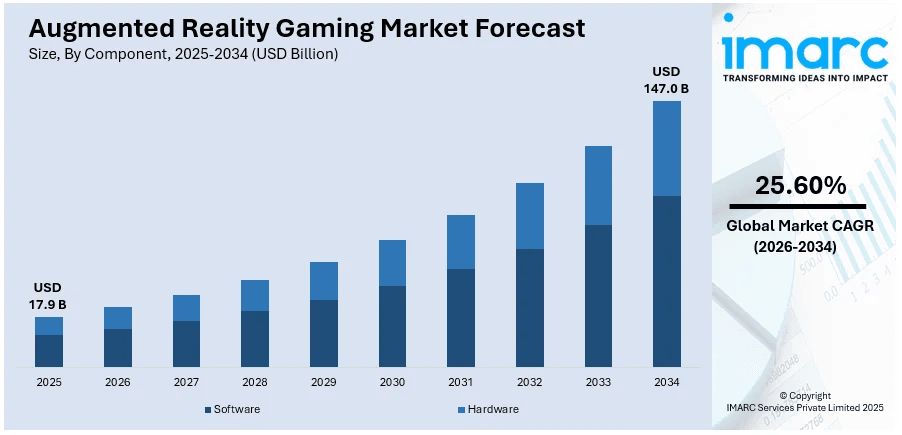
世界の拡張現実ゲーム市場規模は、2025年に179億米ドルと評価されました。今後、IMARCグループは、市場が2034年までに1,470億米ドルに達し、2026年から2034年にかけて25.60%のCAGRを示すと予測しています。現在、北米が市場を支配しており、2025年には35%を超える大きな市場シェアを占めています。この市場は主に、継続的な技術革新、リモートコラボレーションソリューションの需要の高まり、教育、企業、エンターテイメント分野への技術統合、政府および公共スペースによる製品の広範な利用によって推進されています。
現在、市場は技術の進歩とモバイルゲーマーの増加に牽引されています。ゲームにおいて、仮想現実(VR)とは異なり、拡張現実(AR)は既存の環境を活用し、様々な特徴をオーバーレイすることで拡張性を高めます。さらに、ARはデバイスのカメラを用いて、迫力ある映像、グラフィック、サウンドをプレイヤーに提供することが可能です。スマートフォンゲームでは、ARはプレイヤーが独自のキャラクター、ターゲット、レースコースを作成できるため、重要なツールとなっています。さらに、ARゲームの機能により、ユーザーは周囲の環境をスキャンして近隣のプレイヤーを招待し、仮想コースを作成できるようになり、市場のポテンシャルを拡大しています。
IMARCグループは、世界の拡張現実(AR)ゲーム市場の各セグメントにおける主要トレンドの分析に加え、2026年から2034年にかけての世界、地域、国レベルの予測を提供しています。市場は、コンポーネント、テクノロジー、デバイス、ゲームの種類、地域に基づいて分類されています。
Report Overview
The global augmented reality gaming market size was valued at USD 17.9 Billion in 2025. Looking forward, IMARC Group estimates the market to reach USD 147.0 Billion by 2034, exhibiting a CAGR of 25.60% from 2026-2034. North America currently dominates the market, holding a significant market share of over 35% in 2025. The market is primarily driven by continual technological innovations, the growing demand for remote collaboration solutions, technology integration into education, corporate, and entertainment sectors, and widespread product utilization by government and public spaces.
The market is currently being driven by technological advancements, coupled with a rising number of mobile gamers. In gaming, unlike virtual reality, augmented reality utilizes the existing environment and enhances it with an overlay of distinct features. In addition, augmented reality helps in creating a view for the players with intense video, graphics, and sound by using a device-camera. For games on smartphones, augmented reality has become an important tool as it enables gamers to create their own characters, targets, and racing terrains. Further, the functionality of AR games to enable the users to scan their local surroundings so as to invite their neighbors and create a virtual track, is expanding the market potential.
The United States is one of the key markets for augmented reality gaming. The escalating demand for interactive and realistic gaming experiences among young people represents one of the major factors spurring the AR gaming market growth in the country. The market for AR gaming is witnessing significant growth due to the increasing availability of advanced AR headsets from leading brands like Apple and Meta. Devices such as the Apple Vision Pro and Meta Quest 3 are making immersive gaming experiences more accessible to consumers. Additionally, the widespread adoption of 5G networks is revolutionizing cloud gaming by enhancing data transmission speeds and reducing latency, enabling developers to create more dynamic and realistic AR gaming environments. Innovations in motion-capture technology and the integration of haptic bodysuits are further enhancing gameplay by allowing players to feel physical feedback, adding a new level of immersion. For example, in October 2024, Meta unveiled its Orion AR glasses, demonstrating their gaming potential with applications like AR Pong, showcasing the exciting possibilities for the future of AR gaming.
AUGMENTED REALITY GAMING MARKET TRENDS:
Increasing Integration of Augmented Reality in Mobile Gaming
The mobile gaming industry is experiencing development and the adoption of AR in mobile games has transformed playing games. The number of mobile AR users is projected to reach about 1.73 Billion by the end of 2024. AR games combine the digital world and physical reality, which can offer players an unprecedented immersive experience. AR mobile games can provide a new level of analysis and interaction by placing virtual elements over the elements of the real world. This introduction lays the basis for further experiencing how AR experience might affect the gaming ecosystem, which can blur any notions that separate reality from the gaming world. With AR mobile gaming technology becoming one of the most dynamic digital worlds, it opens up new opportunities for both game developers and gamers.
Expansion of Wearable AR Gaming Devices
The increasing adoption of wearable AR devices, including AR glasses and headsets, which provide hands-free and fully immersive experiences is one of the key trends shaping the market outlook. In 2020, digital health wearable companies secured over USD 815 Million across 32 venture funding rounds. Key technology companies including Meta, Apple, and Google are investing heavily in AR hardware development, aiming to deliver powerful devices tailored for gaming, social interaction, and virtual worlds. Wearable devices enable players to interact with digital objects and avatars within real-world environments, bringing a new level of immersion that enhances gameplay. These advancements are anticipated to push AR gaming into the mainstream, with experiences that blend real and virtual elements seamlessly. As AR hardware becomes more affordable and accessible, wearable devices can significantly impact the future of AR gaming.
Increasing Adoption in Social and Multiplayer Gaming
Social connectivity is a major driver in the gaming industry. Many developers are incorporating social and multiplayer features within AR games, allowing players to interact with friends and strangers in real-world settings. There are currently an estimated 3.09 Billion active video game players worldwide. This trend not only enhances the entertainment value but also boosts player retention and engagement by making games more social. Players can now participate in real-time AR tournaments, team-based challenges, and shared experiences that encourage collaboration and competition. The blend of AR and social gaming is expected to attract a wider audience and stimulate further development of community-based AR games, ultimately solidifying AR’s role in the broader gaming landscape.
AUGMENTED REALITY GAMING INDUSTRY SEGMENTATION:
IMARC Group provides an analysis of the key trends in each segment of the global augmented reality gaming market, along with forecasts at the global, regional, and country levels from 2026-2034. The market has been categorized based on component, technology, device, game type, and region.
Analysis by Component
- Software
- Hardware
Hardware leads the market with over 58% market share in 2025. The growth is largely driven by advancements in AR-specific devices such as headsets, smart glasses, and controllers. These innovations provide immersive experiences through higher-resolution displays, precise motion tracking, and tactile feedback, enabling developers to create more interactive and realistic gaming environments. The growing affordability of AR hardware, coupled with their integration into gaming ecosystems, has further spurred adoption. Moreover, companies including Meta, Apple, and Magic Leap continue to invest heavily in AR technology, enhancing accessibility and functionality, which appeals to both gamers and developers. This technological push aligns with consumer demand for next-gen gaming experiences that blend the physical and digital worlds seamlessly.
Analysis by Technology:
Access the comprehensive market breakdown Request Sample
- RFID
- GPS
- Mobile Tracking
- Others
RFID (Radio Frequency Identification) technology is pivotal in shaping the AR gaming market by enhancing interactivity. RFID is widely used to integrate physical objects into AR games, allowing players to interact with tagged items that can trigger specific digital responses in the game environment. This technology provides a tactile dimension to AR gaming, making it more engaging, particularly in scavenger hunts or adventure games where physical interaction plays a central role.
GPS technology drives location-based AR gaming, such as in games like Pokémon GO. By leveraging real-world geographic data, GPS allows players to explore physical environments while engaging with AR overlays. This creates immersive, outdoor gaming experiences that blend physical movement with digital storytelling. The technology enables innovative gameplay mechanics that bridge the gap between the virtual and real worlds, driving the AR gaming industry’s growth and its appeal across diverse audiences.
Analysis by Device:
- Mobiles
- HMDs
- Smart Glasses
HMDs leads the market with around 55% market share in 2025. The innovation in display technologies such as LCD, OLED, or micro display offers high-resolution, 3D viewing, and low latency that improve visual quality and allow manufacturers to produce HMDs with higher pixel densities, a wider color gamut, and better refresh rates. The latest technologies have significantly enhanced the user experience and provided a lucrative growth opportunity for the market.
Analysis by Game Type:
- Racing Games
o Adventure Games
o Fighting Games
o Shooting Games
o Mystery Thriller Games
o Puzzle Games
o Science Fiction Games
o Others
Shooting games segment leads the market with over 20% market share in 2025. The shooting games are experiencing remarkable growth, driven by the release of highly immersive and action-packed titles. These games often test the player’s speed and reaction time and include many subgenres that have the commonality of focusing on the actions of the avatar using some sort of weapons. On the other hand, with 3D detailed graphics, controllers, and sensors in adventure games, adults and children find them more fascinating and interactive.
Regional Analysis:
- North America United States Canada
o United States
o Canada
o Europe Germany France United Kingdom Italy Spain Russia Others
- Germany
- France
o United Kingdom
- Italy
- Spain
- Russia
o Others
o Asia Pacific China Japan India South Korea Australia Indonesia Others
- China
- Japan
- India
- South Korea
- Australia
- Indonesia
o Others
o Latin America Brazil Mexico Others
- Brazil
- Mexico
o Others
- Middle East and Africa
o United States
o Canada
o Germany
o France
o United Kingdom
o Italy
o Spain
o Russia
o Others
o China
o Japan
o India
o South Korea
o Australia
o Indonesia
o Others
o Brazil
o Mexico
o Others
In 2025, North America accounted for the largest market share of over 35%. North America, particularly led by the United States and Canada, stands as the largest market in various global industries, a position underpinned by several key factors. The region boasts a robust and diversified economy, characterized by high consumer spending power and a strong presence of multinational corporations. This economic strength creates a fertile ground for both technological innovation and market consumption. The technological landscape in North America is particularly influential. The region is a global leader in technological advancement, driving trends in IT, digital media, and biotechnology. This leadership in technology not only fuels domestic market growth but also sets global standards and practices.
Augmented Reality Gaming Market Report Scope:
| Report Features | Details |
|---|---|
| Base Year of the Analysis | 2025 |
| Historical Period | 2020-2025 |
| Forecast Period | 2026-2034 |
| Units | Billion USD |
| Scope of the Report | Exploration of Historical and Forecast Trends, Industry Catalysts and Challenges, Segment-Wise Historical and Future Market Assessment:
|
| Components Covered | Software, Hardware |
| Technologies Covered | RFID, GPS, Mobile Tracking, Others |
| Devices Covered | Mobiles, HMDs, Smart Glasses |
| Game Types Covered | Racing Games, Adventure Games, Fighting Games, Shooting Games, Mystery Thriller Games, Puzzle Games Science Fiction Games, Others |
| Regions Covered | Asia Pacific, Europe, North America, Latin America, Middle East and Africa |
| Countries Covered | United States, Canada, Germany, France, United Kingdom, Italy, Spain, Russia, China, Japan, India, South Korea, Australia, Indonesia, Brazil, Mexico |
| Companies Covered | Augmented Pixels, Aurasma, Blippar, Catchoom, Infinity Augmented Reality, Metaio, Qualcomm, Total Immersion, VividWorks, Wikitude, Zappar, etc. |
| Customization Scope | 10% Free Customization |
| Post-Sale Analyst Support | 10-12 Weeks |
| Delivery Format | PDF and Excel through Email (We can also provide the editable version of the report in PPT/Word format on special request) |
Key Regional Takeaways:
UNITED STATES AUGMENTED REALITY MARKET ANALYSIS
The United States accrued a market share of over 83% in 2025. High smartphone penetration, technological improvements, and the expanding gaming culture among younger populations are the main drivers of the augmented reality (AR) gaming market in the United States. Around 90% of American adults have a smartphone as of 2023, making AR games like Minecraft Earth and Pokémon GO widely accessible. According to a research study, around 32% (1 in 3) of Americans are interested in playing augmented reality video games. High-quality gaming experiences are made possible by the robust presence of tech behemoths like Apple, Google, and Microsoft, which encourage innovation in AR hardware and software. AR glasses and headsets, such as the Microsoft HoloLens, provide immersive gaming experiences, while Apple’s ARKit and Google’s ARCore have transformed the creation of AR games.
The market gains from the rising desire for social networking and interactive enjoyment through gaming. In line with the expanding social gaming trend, multiplayer augmented reality games promote cooperation and competition. By lowering latency and enhancing real-time interactions, investments in 5G infrastructure improve the performance of AR games. Additionally, players and viewers are drawn to esports and AR game streaming platforms, which opens up new revenue streams. Gamification apps for fitness and education are also on the rise in the US market, making it harder to distinguish between enjoyment and usefulness. The AR gaming industry in the United States is expected to grow rapidly due to ongoing technology advancements and customer interest.
EUROPE AUGMENTED REALITY MARKET ANALYSIS
The tech-savvy populace, increased smartphone usage, and substantial investments in immersive technology in Europe are driving the AR gaming business. Because of their robust infrastructure and vibrant gaming communities, nations like Germany, the UK, and France dominate the market. Europe’s strong 5G rollout, which allows for improved multiplayer experiences and fluid games, also encourages the adoption of AR gaming. Europe is a very lucrative market for both VR and AR technology as both are constantly expanding. In the upcoming years, the European VR and AR market is anticipated to expand more than 20%.
ASIA PACIFIC AUGMENTED REALITY MARKET ANALYSIS
The vast gaming population, technical developments, and widespread smartphone use in the Asia-Pacific area are propelling the market for augmented reality gaming. India, South Korea, Japan, and China are among the top contributors. In India, the number of mobile gamers has increased dramatically over the past ten years, reaching 507 million in 2022, and more exponential growth is anticipated in the years to come. On similar lines, in 2023, Japan saw a rise in the use of VR and AR technologies, and this trend is predicted to continue. Numerous well-known games, such as Gran Turismo 7, Horizon Call of the Mountain, and Hatsune Miku, have been converted into VR/AR experiences, expanding the possibilities of conventional gaming. Due to its thriving gaming industry and extensive use of mobile games with augmented reality, China is among the dominating markets. Development is further supported by South Korea’s cutting-edge 5G infrastructure and Japan’s proficiency in innovative games.
The vibrant entertainment culture in Asia-Pacific and the rising interest in immersive technology further contribute to the popularity of AR gaming. As disposable incomes rise, more people can afford more sophisticated gaming hardware, and governments and commercial companies are investing in AR gaming platforms. Furthermore, esports and streaming services generate new sources of income, and competitive gamers are increasingly drawn to augmented reality gaming.
LATIN AMERICA AUGMENTED REALITY MARKET ANALYSIS
The market for AR games in this region is growing owing to its young, tech-savvy population and growing smartphone penetration. Leading nations like Brazil and Mexico are taking advantage of more accessible smartphones and better internet infrastructure. The success of AR games like Pokémon GO is an indicator of the region’s passion for cutting-edge entertainment. Local creators are starting to add regional and cultural elements to augmented reality games to attract more players.
MIDDLE EAST AND AFRICA AUGMENTED REALITY MARKET ANALYSIS
Growing investments in digital infrastructure and the gaming industry are driving growth in the Middle East and Africa AR gaming market. With their emphasis on developing into international gaming hubs, holding events, and encouraging game development, the United Arab Emirates and Saudi Arabia are setting the standard. The need for AR gaming solutions is expected to increase due to the region’s youthful population and increased interest in digital entertainment.
COMPETITIVE LANDSCAPE:
The competitive landscape of the gaming market characterizes the analysis of key players. At present, the companies in the market are strategically implementing various developments, including new product launches, partnerships, mergers, and others to strengthen their positions and capitalize on the industry’s growth potential. For instance, in February 2024, Apple launched Vision Pro headsets with its advanced 3D vision technology that offers users an enhanced sense of presence while exploring virtual worlds.
KEY QUESTIONS ANSWERED IN THIS REPORT
- How big is the augmented reality gaming market?
- What is the future outlook of the augmented reality gaming market?
- What are the key factors driving the augmented reality gaming market?
- Which region accounts for the largest augmented reality gaming market share?
- Which are the leading companies in the global augmented reality gaming market?
Table of Contents
1 Preface
2 Scope and Methodology
2.1 Objectives of the Study
2.2 Stakeholders
2.3 Data Sources
2.3.1 Primary Sources
2.3.2 Secondary Sources
2.4 Market Estimation
2.4.1 Bottom-Up Approach
2.4.2 Top-Down Approach
2.5 Forecasting Methodology
3 Executive Summary
4 Introduction
4.1 Overview
4.2 Key Industry Trends
5 Global Augmented Reality Gaming Market
5.1 Market Overview
5.2 Market Performance
5.3 Impact of COVID-19
5.4 Market Breakup by Component
5.5 Market Breakup by Technology
5.6 Market Breakup by Device
5.7 Market Breakup by Game Type
5.8 Market Breakup by Region
5.9 Market Forecast
5.10 SWOT Analysis
5.10.1 Overview
5.10.2 Strengths
5.10.3 Weaknesses
5.10.4 Opportunities
5.10.5 Threats
5.11 Value Chain Analysis
5.11.1 Overview
5.11.2 Research and Development
5.11.3 Input
5.11.4 Products and Services
5.11.5 Marketing and Distribution
5.11.6 End-Users
5.11.7 Post Sales Services
5.12 Porters Five Forces Analysis
5.12.1 Overview
5.12.2 Bargaining Power of Buyers
5.12.3 Bargaining Power of Suppliers
5.12.4 Degree of Competition
5.12.5 Threat of New Entrants
5.12.6 Threat of Substitutes
5.13 Price Analysis
6 Market Breakup by Component
6.1 Software
6.1.1 Market Trends
6.1.2 Market Forecast
6.2 Hardware
6.2.1 Market Trends
6.2.2 Market Forecast
7 Market Breakup by Technology
7.1 RFID
7.1.1 Market Trends
7.1.2 Market Forecast
7.2 GPS
7.2.1 Market Trends
7.2.2 Market Forecast
7.3 Mobile Tracking
7.3.1 Market Trends
7.3.2 Market Forecast
7.4 Others
7.4.1 Market Trends
7.4.2 Market Forecast
8 Market Breakup by Device
8.1 Mobiles
8.1.1 Market Trends
8.1.2 Market Forecast
8.2 HMDs
8.2.1 Market Trends
8.2.2 Market Forecast
8.3 Smart Glasses
8.3.1 Market Trends
8.3.2 Market Forecast
9 Market Breakup by Game Type
9.1 Racing Games
9.1.1 Market Trends
9.1.2 Market Forecast
9.2 Adventure Games
9.2.1 Market Trends
9.2.2 Market Forecast
9.3 Fighting Games
9.3.1 Market Trends
9.3.2 Market Forecast
9.4 Shooting Games
9.4.1 Market Trends
9.4.2 Market Forecast
9.5 Mystery Thriller Games
9.5.1 Market Trends
9.5.2 Market Forecast
9.6 Puzzle Games
9.6.1 Market Trends
9.6.2 Market Forecast
9.7 Science Fiction Games
9.7.1 Market Trends
9.7.2 Market Forecast
9.8 Others
9.8.1 Market Trends
9.8.2 Market Forecast
10 Market Breakup by Region
10.1 North America
10.1.1 Market Trends
10.1.2 Market Forecast
10.2 Europe
10.2.1 Market Trends
10.2.2 Market Forecast
10.3 Asia Pacific
10.3.1 Market Trends
10.3.2 Market Forecast
10.4 Middle East and Africa
10.4.1 Market Trends
10.4.2 Market Forecast
10.5 Latin America
10.5.1 Market Trends
10.5.2 Market Forecast
11 Competitive Landscape
11.1 Market Structure
11.2 Key Players
11.3 Profiles of Key Players
11.3.1 Augmented Pixels
11.3.2 Aurasma
11.3.3 Blippar
11.3.4 Catchoom
11.3.5 Infinity Augmented Reality
11.3.6 Metaio
11.3.7 Qualcomm
11.3.8 Total Immersion
11.3.9 VividWorks
11.3.10 Wikitude
11.3.11 Zappar
List of Tables
Table 1: Global: Augmented Reality Gaming Market: Key Industry Highlights, 2025 & 2034
Table 2: Global: Augmented Reality Gaming Market Forecast: Breakup by Component (in Million USD), 2026-2034
Table 3: Global: Augmented Reality Gaming Market Forecast: Breakup by Technology (in Million USD), 2026-2034
Table 4: Global: Augmented Reality Gaming Market Forecast: Breakup by Device (in Million USD), 2026-2034
Table 5: Global: Augmented Reality Gaming Market Forecast: Breakup by Game Type (in Million USD), 2026-2034
Table 6: Global: Augmented Reality Gaming Market Forecast: Breakup by Region (in Million USD), 2026-2034
Table 7: Global: Augmented Reality Gaming Market: Competitive Structure
Table 8: Global: Augmented Reality Gaming Market: Key Players
List of Figures
Figure 1: Global: Augmented Reality Gaming Market: Major Drivers and Challenges
Figure 2: Global: Augmented Reality Gaming Market: Sales Value (in Billion USD), 2020-2025
Figure 3: Global: Augmented Reality Gaming Market: Breakup by Component (in %), 2025
Figure 4: Global: Augmented Reality Gaming Market: Breakup by Technology (in %), 2025
Figure 5: Global: Augmented Reality Gaming Market: Breakup by Device (in %), 2025
Figure 6: Global: Augmented Reality Gaming Market: Breakup by Game Type (in %), 2025
Figure 7: Global: Augmented Reality Gaming Market: Breakup by Region (in %), 2025
Figure 8: Global: Augmented Reality Gaming Market Forecast: Sales Value (in Billion USD), 2026-2034
Figure 9: Global: Augmented Reality Gaming Industry: SWOT Analysis
Figure 10: Global: Augmented Reality Gaming Industry: Value Chain Analysis
Figure 11: Global: Augmented Reality Gaming Industry: Porter’s Five Forces Analysis
Figure 12: Global: Augmented Reality Gaming Market (Software): Sales Value (in Million USD), 2020 & 2025
Figure 13: Global: Augmented Reality Gaming Market Forecast (Software): Sales Value (in Million USD), 2026-2034
Figure 14: Global: Augmented Reality Gaming Market (Hardware): Sales Value (in Million USD), 2020 & 2025
Figure 15: Global: Augmented Reality Gaming Market Forecast (Hardware): Sales Value (in Million USD), 2026-2034
Figure 16: Global: Augmented Reality Gaming Market (RFID): Sales Value (in Million USD), 2020 & 2025
Figure 17: Global: Augmented Reality Gaming Market Forecast (RFID): Sales Value (in Million USD), 2026-2034
Figure 18: Global: Augmented Reality Gaming Market (GPS): Sales Value (in Million USD), 2020 & 2025
Figure 19: Global: Augmented Reality Gaming Market Forecast (GPS): Sales Value (in Million USD), 2026-2034
Figure 20: Global: Augmented Reality Gaming Market (Mobile Tracking): Sales Value (in Million USD), 2020 & 2025
Figure 21: Global: Augmented Reality Gaming Market Forecast (Mobile Tracking): Sales Value (in Million USD), 2026-2034
Figure 22: Global: Augmented Reality Gaming Market (Other Technologies): Sales Value (in Million USD), 2020 & 2025
Figure 23: Global: Augmented Reality Gaming Market Forecast (Other Technologies): Sales Value (in Million USD), 2026-2034
Figure 24: Global: Augmented Reality Gaming Market (Mobiles): Sales Value (in Million USD), 2020 & 2025
Figure 25: Global: Augmented Reality Gaming Market Forecast (Mobiles): Sales Value (in Million USD), 2026-2034
Figure 26: Global: Augmented Reality Gaming Market (HMDs): Sales Value (in Million USD), 2020 & 2025
Figure 27: Global: Augmented Reality Gaming Market Forecast (HMDs): Sales Value (in Million USD), 2026-2034
Figure 28: Global: Augmented Reality Gaming Market (Smart Glasses): Sales Value (in Million USD), 2020 & 2025
Figure 29: Global: Augmented Reality Gaming Market Forecast (Smart Glasses): Sales Value (in Million USD), 2026-2034
Figure 30: Global: Augmented Reality Gaming Market (Racing Games): Sales Value (in Million USD), 2020 & 2025
Figure 31: Global: Augmented Reality Gaming Market Forecast (Racing Games): Sales Value (in Million USD), 2026-2034
Figure 32: Global: Augmented Reality Gaming Market (Adventure Games): Sales Value (in Million USD), 2020 & 2025
Figure 33: Global: Augmented Reality Gaming Market Forecast (Adventure Games): Sales Value (in Million USD), 2026-2034
Figure 34: Global: Augmented Reality Gaming Market (Fighting Games): Sales Value (in Million USD), 2020 & 2025
Figure 35: Global: Augmented Reality Gaming Market Forecast (Fighting Games): Sales Value (in Million USD), 2026-2034
Figure 36: Global: Augmented Reality Gaming Market (Shooting Games): Sales Value (in Million USD), 2020 & 2025
Figure 37: Global: Augmented Reality Gaming Market Forecast (Shooting Games): Sales Value (in Million USD), 2026-2034
Figure 38: Global: Augmented Reality Gaming Market (Mystery Thriller Games): Sales Value (in Million USD), 2020 & 2025
Figure 39: Global: Augmented Reality Gaming Market Forecast (Mystery Thriller Games): Sales Value (in Million USD), 2026-2034
Figure 40: Global: Augmented Reality Gaming Market (Puzzle Games): Sales Value (in Million USD), 2020 & 2025
Figure 41: Global: Augmented Reality Gaming Market Forecast (Puzzle Games): Sales Value (in Million USD), 2026-2034
Figure 42: Global: Augmented Reality Gaming Market (Science Fiction Games): Sales Value (in Million USD), 2020 & 2025
Figure 43: Global: Augmented Reality Gaming Market Forecast (Science Fiction Games): Sales Value (in Million USD), 2026-2034
Figure 44: Global: Augmented Reality Gaming Market (Other Games): Sales Value (in Million USD), 2020 & 2025
Figure 45: Global: Augmented Reality Gaming Market Forecast (Other Games): Sales Value (in Million USD), 2026-2034
Figure 46: North America: Augmented Reality Gaming Market: Sales Value (in Million USD), 2020 & 2025
Figure 47: North America: Augmented Reality Gaming Market Forecast: Sales Value (in Million USD), 2026-2034
Figure 48: Europe: Augmented Reality Gaming Market: Sales Value (in Million USD), 2020 & 2025
Figure 49: Europe: Augmented Reality Gaming Market Forecast: Sales Value (in Million USD), 2026-2034
Figure 50: Asia-Pacific: Augmented Reality Gaming Market: Sales Value (in Million USD), 2020 & 2025
Figure 51: Asia-Pacific: Augmented Reality Gaming Market Forecast: Sales Value (in Million USD), 2026-2034
Figure 52: Middle East and Africa: Augmented Reality Gaming Market: Sales Value (in Million USD), 2020 & 2025
Figure 53: Middle East and Africa: Augmented Reality Gaming Market Forecast: Sales Value (in Million USD), 2026-2034
Figure 54: Latin America: Augmented Reality Gaming Market: Sales Value (in Million USD), 2020 & 2025
Figure 55: Latin America: Augmented Reality Gaming Market Forecast: Sales Value (in Million USD), 2026-2034